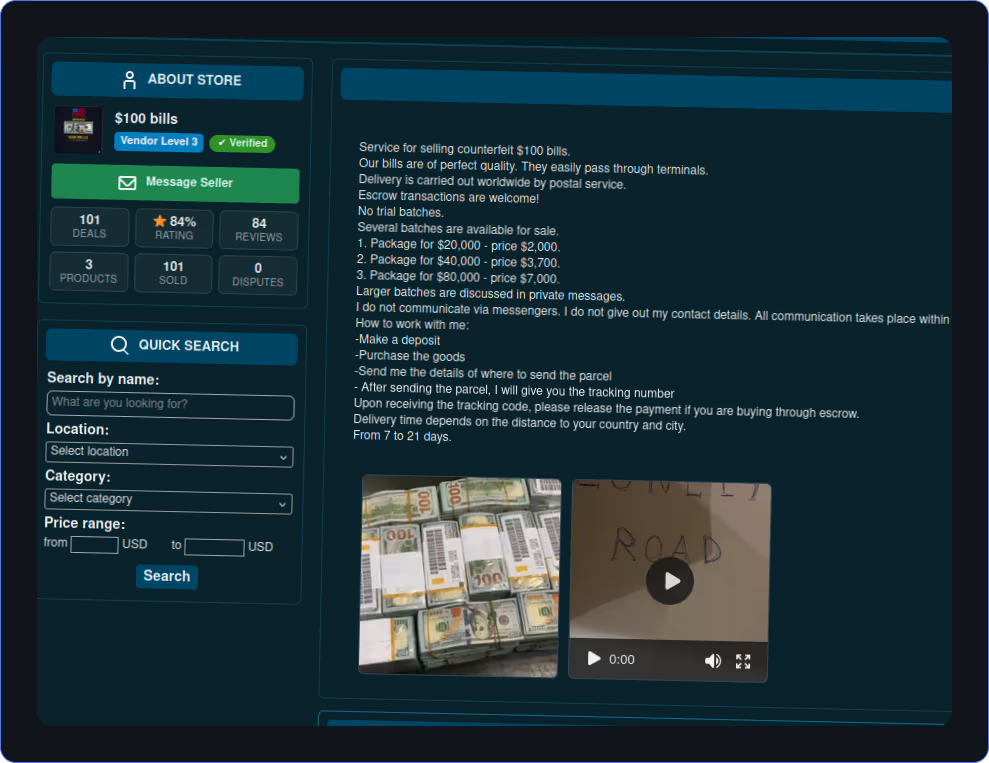
We examined a case from January 2025 involving Derek H., who thought he had outsmarted modern banking by feeding prop money dollars into cash-accepting ATMs. The 29-year-old Colorado resident spent $1,200 in cryptocurrency on a darknet marketplace to buy fake dollars — specifically, 40 counterfeit $20 dollar bills and $100 notes from the 2009 series. The fake money site promised these were "superdollar" grade: realistic fake money with functional UV features, magnetic strips, and watermarks.
Derek's plan relied on a simple premise. ATMs that accept cash deposits scan bills and credit your account balance instantly. He figured once the fake 100 dollar note turned into a digital entry, he could withdraw clean funds or transfer them elsewhere. The counterfeit $100 dollar bill batch he purchased seemed convincing enough to fool the initial machine scan. For a brief window, the scheme appeared to work — until the U.S. Secret Service knocked on his door three weeks later.
Many people assume ATM cash scanners represent the final word on authenticity. On closer inspection, these machines perform only preliminary checks at the point of deposit. The real verification happens behind the scenes, where banks apply multiple layers of fraud detection that most fake money dollar bills cannot survive.
1. How the ATM Deposits Unfolded
Derek started his experiment at four different ATMs over two days. The first machine accepted $400 in fake counterfeit money without hesitation, crediting his account immediately. The second ATM processed another $400. At the third location, one bill was rejected with a generic error message — the machine simply returned it. The fourth ATM accepted the remaining bills but marked the transaction "pending review."
This mixed result is typical. ATMs use optical and magnetic sensors to perform rapid checks: bill size, ink patterns, magnetic ink signature, and sometimes UV features. High-quality prop money for sale on darknet markets now replicates enough of these traits to pass the initial scan. The counterfeit $20 dollar bills and hundreds Derek bought likely had decent magnetic ink and passable watermarks, enough to fool the ATM's front-line sensors.
The pending-review flag, however, signals that the machine's confidence score fell below a threshold. Banks don't reject borderline bills outright at the ATM — they accept the deposit provisionally and queue the transaction for manual or automated secondary review. Derek's account showed the full credited amount overnight, but the bank had already begun its backend analysis.
2. Why the Bank Flagged the Transactions
By the next morning, Derek's account was frozen. We traced the timeline: ATM deposits occurred late afternoon and evening; the freeze happened roughly 12 hours later. Banks run nightly batch processes that cross-check deposited cash against multiple databases and apply machine-learning fraud models.
Three factors likely triggered the alert. First, serial numbers: genuine U.S. currency has unique serials, but counterfeit batches often share identical or sequenced numbers across multiple bills. When Derek deposited 40 bills in quick succession, the bank's system would have noticed repeated serials. Second, deposit pattern: four ATM visits in two days, all cash, all large denominations, is statistically unusual for a typical consumer account. Third, the pending-review flag from the fourth ATM acted as a red flag, prompting human review of all recent deposits from that account.
Once a bank suspects counterfeit currency, federal law requires them to notify the Secret Service. The agency has jurisdiction over all U.S. currency crimes. Within three weeks, agents had traced Derek's cryptocurrency transaction on the fake money darknet marketplace, identified his delivery address, and obtained a warrant. He was arrested and charged with possession and attempted use of fake 100 dollar notes.
3. What Darknet Sellers Promise Versus Reality
The marketplace listing Derek used advertised "superdollar quality" — a term that originally referred to North Korean counterfeits rumored to be nearly perfect. Modern fake money sites use this label liberally. We reviewed similar listings: sellers claim UV-reactive threads, color-shifting ink, microprinting, and tactile features. Prices for buy fake dollars packages range from $800 to $2,000 per batch, depending on denomination and quantity.
In practice, even the best buy counterfeit 20 dollar bills available on these platforms fall short of genuine currency under forensic examination. Superdollars from the 1990s and early 2000s used intaglio printing presses similar to government equipment; today's darknet offerings rely on high-resolution inkjet or offset printers. The tactile feel, paper composition (U.S. notes use cotton-linen blend, not wood pulp), and infrared signatures remain difficult to replicate.
Derek's seller likely delivered realistic fake money that could fool a casual human glance or a basic pen test, but not the multi-spectral scanners and database checks banks deploy. Australian and European markets face similar issues: realistic fake money australia listings promise polymer-note forgeries, yet central banks report detection rates above 95 percent at financial institutions.
4. The Role of ATM Technology and Bank Backend Systems
ATMs are not designed to be foolproof counterfeit detectors. Their primary job is speed and convenience; they perform a risk assessment and accept deposits provisionally. The machine logs high-resolution images of every bill, recording serial numbers, scan quality scores, and sensor readings. This data feeds into the bank's central fraud system.
Banks compare deposited bills against a Secret Service database of known counterfeit serials and against the account holder's behavior profile. An account that suddenly deposits large amounts of cash — especially after years of mostly digital transactions — raises algorithmic red flags. The pending-review status Derek encountered indicates the ATM's sensors registered anomalies: perhaps the magnetic signature was slightly off, or the UV thread fluoresced inconsistently.
Once flagged, human analysts or advanced AI tools examine the scanned images. Counterfeit notes often show pixelation in microprint areas, ink bleed in fine lines, or incorrect color values in security threads. Even if the fake dollar price on the darknet seems low enough to justify the risk, the backend verification stack makes large-scale ATM fraud nearly impossible to sustain beyond a few transactions.
5. Legal Consequences and Secret Service Involvement
Derek faced federal charges: possession of counterfeit obligations (18 U.S.C. § 472) and attempted fraud. Conviction carries up to 20 years in prison and fines. The Secret Service prioritizes cases involving organized distribution networks, but individual users who buy fake dollars and attempt to pass them are prosecuted routinely.
The agency traced Derek's cryptocurrency payment through blockchain analysis, identifying the exchange he used and leveraging Know Your Customer records to confirm his identity. The darknet marketplace operated on Tor, but most users make operational security mistakes: reusing email addresses, shipping to home addresses, or cashing out crypto through regulated exchanges. Derek's delivery address matched his bank account registration, making the investigation straightforward.
Beyond criminal penalties, Derek's bank account remains frozen, and he will likely face civil forfeiture of any funds traced to the counterfeit deposits. His credit record will carry the fraud flag for years, complicating future financial services access. The fake money darknet vendor, meanwhile, continues to operate — law enforcement focuses on buyers as much as sellers, since each arrest can yield intelligence on distribution channels.
Why the Scheme Was Doomed from the Start
Derek's case illustrates why ATM deposit schemes fail despite initial success. The machines' front-end sensors are only the first checkpoint; banks' backend fraud systems, serial-number databases, and behavioral analytics form a layered defense that catches counterfeit currency within hours. Even high-quality prop money for sale nearby or online cannot replicate the full spectrum of security features U.S. notes possess, especially under forensic and digital scrutiny.
We also note the legal exposure: buying and using fake counterfeit money is a federal offense with severe penalties, and modern investigative tools — blockchain tracing, ATM imaging, and interagency databases — make anonymity nearly impossible. The perceived arbitrage between fake dollar price on darknet markets and face value collapses once you factor in arrest risk, asset forfeiture, and prison time.
For anyone researching counterfeit currency from an academic or security perspective, this case underscores the sophistication of modern anti-fraud infrastructure. The gap between darknet marketing claims and real-world performance remains wide, and financial institutions invest heavily in closing it further every year.
Sources